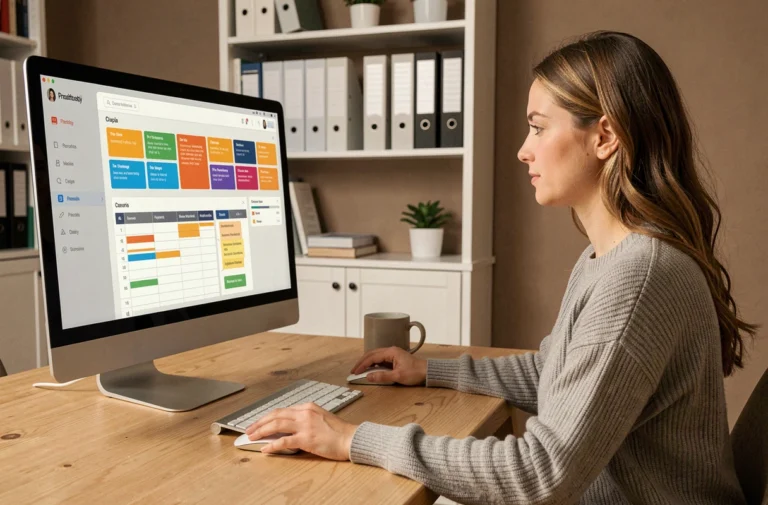
A site that brings together dozens of resources on management, sales, or business strategy can quickly become a labyrinth. Finding a specific article among multiple categories takes time, especially when the search bar is not sufficient. The HTML sitemap provides a structured view of all content, but its value directly depends on how it is designed and used.
HTML Sitemap and XML Sitemap: Two Tools, Two Distinct Functions
| Criterion | HTML Sitemap | XML Sitemap |
|---|---|---|
| Main Recipient | Human Visitor | Crawling Bot (Googlebot, Bingbot) |
| Format | Clickable navigable web page | Machine-readable technical file |
| Usual Location | Footer or navigation menu | Server root (/sitemap.xml) |
| Direct SEO Impact | Internal linking to deep pages | Crawling signal for bots |
| User Experience Impact | Quick access to any section | None (invisible to the visitor) |
The confusion between these two formats is common. The XML sitemap informs search engines about the URLs to explore. The HTML sitemap guides the visitor to the content they are looking for. The two complement each other, but only the HTML serves daily navigation.
SEO audits conducted by the French agency Semji in 2024 confirm that well-structured and regularly updated HTML sitemaps contribute to better crawling of deep pages by bots. Several case studies published in 2023-2024 show a notable increase in organic traffic to previously buried content when the sitemap is highlighted in the main menu or footer.
To access the complete structure of training, marketing, management, or performance sections, the Businessmindset sitemap gathers all available pages in one view.

Navigation by Profile: Filtering a Sitemap According to Purpose
A trainer looking for content on team communication does not have the same needs as a leader focused on sales strategy. UX recommendations published by Nielsen Norman Group in 2023-2024 suggest that sitemaps benefit from becoming interactive navigation maps rather than simple lists of links. Adding filters by profile, level, or goal increases the click-through rate to deep pages.
This approach requires rigorous categorization of content. On a business and management-oriented site, three sorting axes naturally emerge:
- By job theme (sales, management, marketing, management, communication) to directly target a specific area of expertise
- By level of expertise (beginner, intermediate, advanced) to avoid landing on an article that is too basic or too technical
- By content format (long article, practical guide, case study) to adapt reading to the available time
Even without an interactive filter, a sitemap organized along these axes allows for scanning the page in a few seconds. The structure of titles and subtitles in the sitemap replaces the internal search engine for visitors who prefer to browse visually.
Accessibility and WCAG 2.2 Compliance: What the Sitemap Must Adhere To
The WCAG 2.2, published in October 2023 by the W3C, strengthen the requirements for keyboard navigation and tag hierarchy. A sitemap that does not meet these criteria can render the site non-compliant in terms of digital accessibility.
Three technical points deserve special attention:
- Each section of the sitemap must use hierarchical heading tags (h2, h3) and structured HTML lists, not just visually formatted text
- Keyboard navigation must allow access to any link in the sitemap without a mouse, with a logical tab order
- The sitemap must be clearly indicated in the main navigation or footer, not buried in a secondary page accessible only via a discreet link
An inaccessible sitemap for keyboard users penalizes assistive technology users and undermines the overall compliance of the site. For a site aimed at professionals and trainers, this dimension is not secondary: it conditions access for all audiences to the resources offered.

Internal Linking and SEO: The Sitemap as a Lever for Deep Pages
The oldest or most specialized pages of a site often end up losing visibility. They are no longer linked from the homepage, recent articles do not mention them, and crawling bots visit them less and less. The HTML sitemap corrects this problem by maintaining an active link to each published page.
Feedback from B2B companies, documented by Content Square and HubSpot in 2023-2024, shows that analyzing clicks on the sitemap reveals the most sought-after content by visitors. This data allows for reorganizing categories, highlighting certain pages, or identifying outdated content that needs updating.
In addition to the XML sitemap submitted to search engines, the HTML sitemap distributes internal link juice to pages that lack it. On a site covering topics as varied as training, business strategy, operational excellence, or customer management, this redistribution prevents entire sections of content from becoming invisible.
The sitemap remains an underestimated tool. Its regular updating, accessible structure, and visible positioning in navigation directly condition a visitor’s ability to find the right content at the right time. For a site that regularly produces new articles on business and management, it is the only place where the entire editorial catalog remains viewable at a glance.